Sapel Blog
What Is Conductive Plastic? (How It Is Made, Advantages and Future Uses)
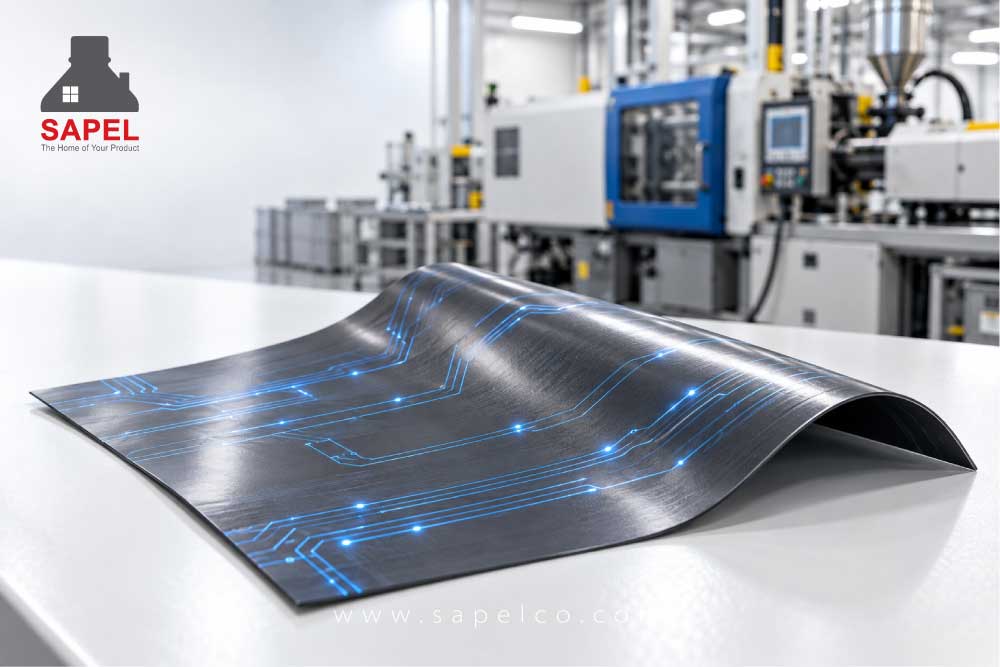
Back in school science lessons, we all learned a simple, universal rule: metals such as copper and aluminum conduct electricity well, while plastics are stubborn insulators, the material of electricians’ safety gloves and the coating on household wires. That picture is so firmly fixed in our minds that the idea of electric current flowing through a piece of plastic sounds like a joke, or at least an impossible paradox.
But materials science keeps surprising us by breaking exactly these boundaries and clichés. What if we told you that today there are plastics that can conduct electricity and carry current just like metals?
These emerging materials, known as conductive plastics, combine the seemingly opposite qualities of two different worlds: the lightness, flexibility and design freedom of traditional plastics, together with the ability to carry electric current and dissipate static charges. This fascinating innovation not only changes the way we think about non-conductive materials, it is also paving the way for a new generation of lighter, safer and smarter technologies.
What Is Conductive Plastic and How Does It Work?
Conductive plastics are engineered polymers that, unlike traditional, ordinary plastics, can conduct electric current or dissipate static electricity. Ordinary plastics have no free electrons, so they are complete insulators; in conductive plastics, the structure of the material has been changed so that electrons can move and current can flow.
How Conductive Plastics Are Made
To turn an insulating plastic into a material that lets electricity through, materials scientists use two completely different methods:
1. Filled (Compounded) Plastics
This is the most common way to produce conductive plastics. The ordinary plastic stays as the base, and during production fine, microscopic conductive particles are mixed into the polymer base, just like other polymer additives. These particles can be carbon black powder, carbon fibers, carbon nanotubes, or metal particles and fibers.
How does it work? When enough of these tiny particles are dispersed through the plastic, they link up like miniature bridges and create continuous paths for electrons to hop along. The fascinating science behind this method is a phenomenon called the “percolation threshold”: as long as the amount of additive stays below a certain level, the plastic remains an insulator, but as soon as the additive reaches a specific, critical amount, conductive paths suddenly form and electrical conductivity jumps dramatically.
2. Intrinsically Conductive Polymers
In this method no foreign material or metal particles are added to the plastic; instead, the molecular structure of the plastic itself is designed to let electricity through.
How does it work? These plastics have a special chemical structure with alternating double bonds along their molecular chain. These bonds allow electrons to travel easily along the length of the polymer chain. Real conductivity, however, is reached only when a very small amount of another substance, such as iodine, is added to the polymer, a process known as “doping.” The best-known polymers of this type are polyacetylene, polyaniline, polypyrrole, polythiophene and PEDOT:PSS, which is used today in displays and sensors.
A historic discovery and a Nobel Prize: in the 1970s, three scientists, Alan Heeger, Alan MacDiarmid and Hideki Shirakawa, were studying a material called polyacetylene when they found that plastics, too, can become conductive like metals under certain conditions. This revolutionary discovery changed the world’s view of non-conductive materials and won them the Nobel Prize in Chemistry in 2000.

The Remarkable Advantages of Conductive Plastics (a New Alternative to Metals)
For years, metals were the unrivaled kings of electrical conduction. With the arrival of conductive plastics, however, engineers realized they no longer had to put up with the heavy weight and manufacturing limits of metals. So what qualities are driving industry to replace metals with conductive plastics?
- A dramatic weight reduction: one of the biggest weaknesses of metals is their weight. Conductive plastics are up to 50% lighter than aluminum and about 80% lighter than steel. In modern industries such as electric vehicles, aircraft and aerospace parts, this weight saving is a vital advantage, because less weight means less energy use and a longer range.
- Complete design freedom and easy production: shaping metals requires complex, expensive and time-consuming processes such as machining, cutting and welding. Conductive plastics, on the other hand, can easily be formed into the most complex shapes by plastic injection molding and even 3D printing. This cuts production costs sharply.
- Outstanding resistance to rust and corrosion: metals rust and corrode when exposed to moisture, chemicals and harsh environments. Conductive plastics eliminate this problem and are far more durable against chemical and environmental factors.
- Wave absorption and greater safety: besides carrying current, conductive plastics are remarkably good at absorbing and blocking electromagnetic waves (EMI). This prevents interference in sensitive electronic devices and keeps them working reliably.
Uses of Conductive Plastics in Industry Today
Conductive plastics are not just a thing of the future; they are already in many of the products around us:
- Antistatic packaging for electronic components: trays, boxes and bags that dissipate static charges so that sensitive chips and circuit boards are not damaged.
- Housings for electronic devices: casings that are light and also block electromagnetic interference.
- Automotive parts: parts of the fuel system where static electricity must not build up.
- Containers and tanks for flammable materials: where dissipating static charge reduces the risk of sparks and fire.

The Future of the Technology and Conclusion (a Lighter, Smarter World)
Conductive plastics are more than a simple innovation in materials science; they are a key driver of one of the biggest industrial transformations of our time. Market analysts expect the global conductive plastics market to pass 10 billion dollars soon. This rapid growth reflects modern industry’s growing need for lighter, more energy-efficient and smarter materials.
The most exciting part of this technology, though, is the forward-looking applications that will soon transform our daily lives:
- Transparent solar cells: conductive plastics make it possible to build transparent, flexible solar panels that can be fitted to the windows of high-rise buildings or even to smartphone screens, turning ambient light into energy without the need for a charger.
- Smart windows: windows that use a very weak electric current to adjust, intelligently, how much transparency, light and heat they let into a building.
- Electronic clothing and wearable gadgets: smart fabrics and garments woven with conductive plastic fibers that can monitor vital signs, heart rate or body temperature in real time, without adding any extra weight or metallic stiffness to the clothing.
If you are researching conductive plastics for a school or work project, the two production methods, conductive additives and intrinsically conductive polymers, together with the percolation threshold, are the best place to start; the Nobel Committee’s scientific background report on the 2000 prize is also a reliable source for further reading.
Frequently Asked Questions about Conductive Plastics
Is plastic a conductor or an insulator?
Ordinary plastic is an insulator, which is why it is used to coat wires. Plastic only becomes conductive when conductive particles such as carbon or metal are added to it, or when it has a special molecular structure; in other words, the conductive plastics described in this article.
Does conductive plastic conduct electricity as well as copper?
In most cases, no. Most conductive plastics are less conductive than metals such as copper, but they are perfectly adequate for dissipating static electricity, shielding against electromagnetic waves and making sensors.
What is the difference between antistatic plastic and conductive plastic?
Antistatic plastic is only conductive enough to dissipate static charge slowly and prevent sparks. Conductive plastic carries electric current with much lower resistance and can act as part of a circuit or as a shield against electromagnetic waves.
Can conductive plastic be produced by injection molding?
Yes. Plastics compounded with carbon or metal fibers are supplied as granules and are shaped just like ordinary plastics, by injection molding, extrusion or 3D printing.