
Sapel Blog
What Is Rigid Plastic? (Types, Advantages and Industrial Uses)
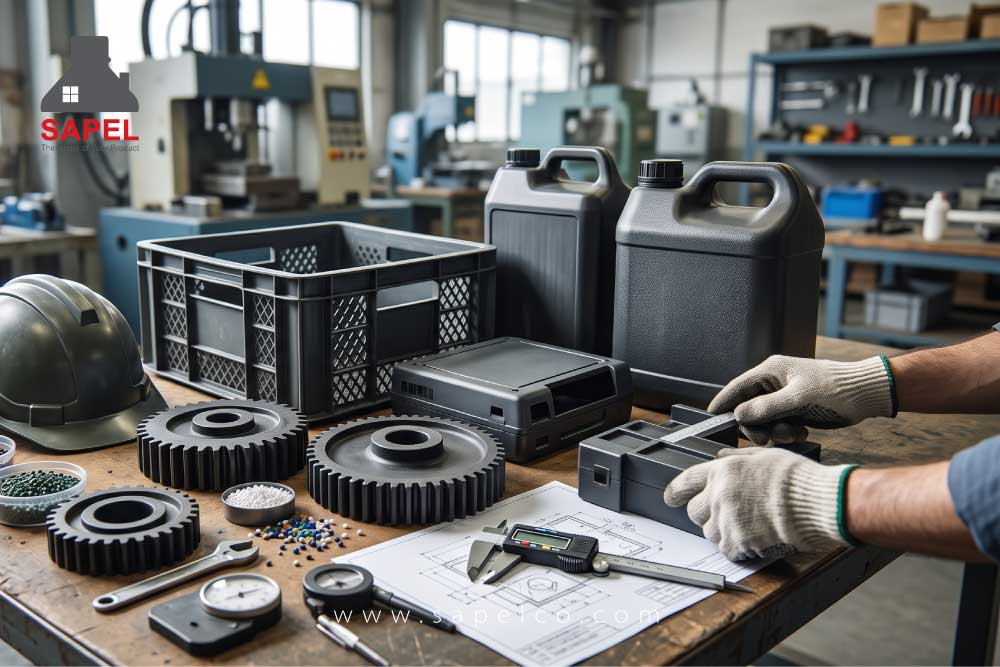
Have you ever noticed, while doing your everyday shopping, why a freezer bag or a sheet of cling film stretches, bends and crumples so easily, while plastic bottles, 20-liter jerrycans and food storage containers keep their firm, sturdy shape? The answer to this very tangible difference lies in one practical concept: hard, or rigid, plastic.
Rigid plastic is the name given to a group of polymers with a fully stable structure that resist deformation, bending and stretching under normal loads. Unlike flexible plastics, these materials are designed to keep their shape and structural strength while they are handled and used day to day.
Today, rigid plastics are everywhere in daily life and across many industries, from packaging chemical, industrial, food and pharmaceutical products to manufacturing car parts, medical equipment and construction. The global market for these products is growing at a remarkable pace: the rigid plastics market was projected to reach a staggering 240 billion dollars by 2025, a figure that shows how central these materials are, and how large their market is, in the modern economy and industry.
What Exactly Is Rigid Plastic?
In engineering, rigidity is a fully measurable property. For a material to be classed as a rigid plastic, specific standard tests are carried out on it to obtain precise figures:
- Flexural modulus: this measures how strongly a plastic resists bending. The higher the value (for example, above 2 GPa in materials such as acrylic and polycarbonate), the more resistant the plastic is to bending.
- Tensile modulus: this shows how well the material resists stretching and tensile forces.
- Surface hardness: this indicates how well the plastic’s surface resists dents, fingernail marks and scratches.
- Heat deflection temperature (HDT): the temperature at which a plastic under a specified mechanical load starts to soften and deform. Rigid plastics keep their dimensional stability at normal working temperatures.
A Common Misconception: “Rigid” Does Not Mean “Brittle”!
Many people assume that any hard plastic will break at the slightest knock, like clear, brittle disposable cups (polystyrene). But that is not always true! In materials science, rigidity and toughness, or impact strength, are two different things. For example, polycarbonate (PC) and ABS are very hard and do not bend, yet they have outstanding impact strength, so much so that polycarbonate is used to make safety glazing, motorcycle helmets and protective shields.

Types of Rigid Plastic
- PET / PETG: clear, strong and fully recyclable; the best choice for beverage bottles and food containers.
- HDPE (high-density polyethylene): extremely resistant to impact and chemicals; ideal for jerrycans, pipes and large industrial pails.
- PP (polypropylene): light, heat-resistant and able to form a “living hinge”; widely used in food storage containers and car parts.
- uPVC / PVC: very durable, flame-resistant and moisture-resistant; suited to window and door profiles and building plumbing.
- PC (polycarbonate): as clear as glass, with unmatched impact strength; used in safety shields and medical equipment.
- PMMA (acrylic): a light, clear, shatterproof alternative to glass with excellent resistance to sunlight; great for signs and display cases.
- ABS: tough, hard and impact-resistant; used in home appliance housings, toys (such as LEGO) and tools.
Simple Home and On-Site Tests to Identify Rigid Plastic
How can you tell whether a plastic is rigid, and even what type it is, at home, in a warehouse or in a workshop, without complicated lab equipment? There are a few simple yet reliable tests that are widely used in practice:
1. The Bend and Sound Test
- How to do it: try to bend the plastic part by hand, or tap it firmly with your finger.
- Result: rigid plastics strongly resist bending and do not change shape. When you tap them, you hear a sharp, dry, distinct sound (like knocking on solid wood), while soft, flexible plastics give a dull, muffled sound.
2. The Fingernail Test
- How to do it: press your fingernail hard into the surface of the plastic, or drag it across.
- Result: rigid and engineering plastics (such as polycarbonate, acrylic or PET) show no mark, dent or line from your nail. If your nail leaves an impression on the surface, you are dealing with a soft or semi-rigid plastic.
3. The Water Float Test
- How to do it: drop a small, clean piece of the plastic into a container of ordinary water.
- Result: this test works on the material’s density. Plastics such as HDPE (code 2) and PP (code 5) are less dense than water and float. Plastics such as PET (code 1), PVC (code 3) and PC, on the other hand, are denser, so they sink to the bottom.
4. Check the Resin Identification Code
- How to do it: look at the recycling triangle symbol molded into the bottom or side of the container.
- Code 1 (PET): clear, strong beverage bottles.
- Code 2 (HDPE): jerrycans, opaque containers and sturdy pails.
- Code 5 (PP): containers for hot food, and caps.
- Code 6 (PS): hard, brittle disposable containers.
- Code 7 (Other): engineering plastics and rigid multilayer plastics such as polycarbonate and ABS.

How Are Rigid Plastics Made?
You may be curious how raw plastic granules and pellets change shape and turn into hard, clear or colored parts with complex forms. Rigid plastics are produced with advanced thermal and mechanical processes, and the method is chosen according to the part’s final shape, wall thickness and application:
1. Injection Molding
In injection molding, plastic granules are melted by heat and injected under high pressure into a precise metal mold. After cooling quickly, the material takes the shape of the mold. It is used to make complex, precise parts in high volumes, such as home appliance housings, toys, hard cases and caps.
2. Blow Molding
In blow molding, molten plastic is formed into a hollow tube, which is then placed inside a mold, and compressed air is blown into it so that the plastic presses against the mold walls. It is used to make hollow, one-piece containers such as beverage bottles, milk jugs, detergent containers and industrial tanks.
3. Thermoforming
Ready-made sheets of rigid plastic are heated until they soften, then drawn over a mold by vacuum or air pressure to take their shape. It is used to make packaging containers, food trays, clear blister packs and interior panels.
4. Extrusion
Molten plastic is pushed continuously through a die with a set cross-section to produce continuous lengths of product. It is used to make water and sewer pipes, uPVC window and door profiles, and flat plastic sheets.
5. CNC Machining
Unlike molding methods, where molten material is shaped, in CNC machining solid blocks or sheets of plastic are cut away with precise, computer-controlled cutting tools. It is used for early prototypes, parts with very tight tolerances and short runs of industrial parts, with no need to build expensive molds.
How Rigid Plastic Is Recycled
Although rigid plastics pollute the environment when they are discarded in nature, their uniform structure and high resin purity make them among the most recyclable materials in industry. Industrial recycling of these materials follows a set cycle: the waste is first collected, then sorted by material and washed thoroughly, then shredded into small flakes, and finally remelted into granules for making new products.
Along the way, the quality and source of the waste matter a great deal. Post-industrial scrap, the clean, uniform waste from factory production lines, is so pure that it is worth far more and recycles into far better material than post-consumer waste, in other words household and municipal garbage. In the end, continuously recycling rigid plastics and feeding them back into production not only reduces the need to extract virgin oil resources, but also saves energy and does a great deal to build a circular economy.
Summary and Conclusion
Thanks to an unmatched combination of durability, mechanical strength and high recyclability, rigid plastics have become one of the pillars of modern industry and of the packaging industry. Knowing the types of these polymers and how to manage their waste is the first step toward using these materials wisely and moving toward a more sustainable future.